
Copart Title Codes Explained: SC, ST, CT, SV, RB, BS and More
By James Dean · 11 min read · Updated November 11, 2026
Between mid-August and mid-November 2026, 628 Toyota Camrys from model years 2015 to 2022 went to sale at Copart US carrying the title code SV. Their median last bid before the live auction was US$450. Camrys of the same years with the code ST drew US$1,200, and those with CT drew US$1,400.
The code isn't the only reason, as we'll see. But those two letters are the first thing on a Copart lot that tells you what kind of paper comes with the car, which state issued it, and what you'll be allowed to do with it afterwards. Copart doesn't publish a list of them: its glossary defines damage codes, but not title codes. This guide fills that gap. It covers what the most common codes mean, state by state, how often each appears, and the handful that should stop you before you bid. It draws on SalvageAlert's records of 770,105 Copart US lots and 21,859 Copart Canada lots.
How to read the title code on a Copart lot
On a Copart lot page the field is labelled Title code, and it reads in three parts: the state, the document, and a group. For example: "MA - Certificate Of Title - Clean Title". In search results the same thing appears the other way round, as "Clean Title (CT - MA)".
The small (i) next to the field opens a tooltip with the document's full name and Copart's title group. A Massachusetts CT reads "CERTIFICATE OF TITLE without brands. This is commonly referred to as a Clean or Clear Title", followed by "Title group:Clean". A Florida CD reads "FL CERTIFICATE OF DESTRUCTION", group Non-Clean. On the lot page Copart uses two groups, Clean and Non-Clean. Its search filter splits Non-Clean further into Salvage Title and Non Repairable.
The two letters on their own are not enough. The same code means different things in different states, and Copart groups them differently. A BS from Alberta reads "Bill of Sale - Active. A vehicle with this status can be registered" and sits in the Clean group. A BS from Kentucky reads "BILL OF SALE/PART ONLY/NO TITL" and sits with the non-repairables. Always read the code together with the state that follows it.
The codes you will see most
Six codes cover 84% of Copart US lots. The top three alone, SC, ST and CT, account for 70%.

The table below lists the codes that appear on at least half a percent of Copart US lots, with the wording Copart gives them, the states they come from and what they mean in practice. The share is of 770,105 Copart US lots with a sale date between August 16 and November 10, 2026.
| Code | Copart wording | Share | Main title states | What it means |
|---|---|---|---|---|
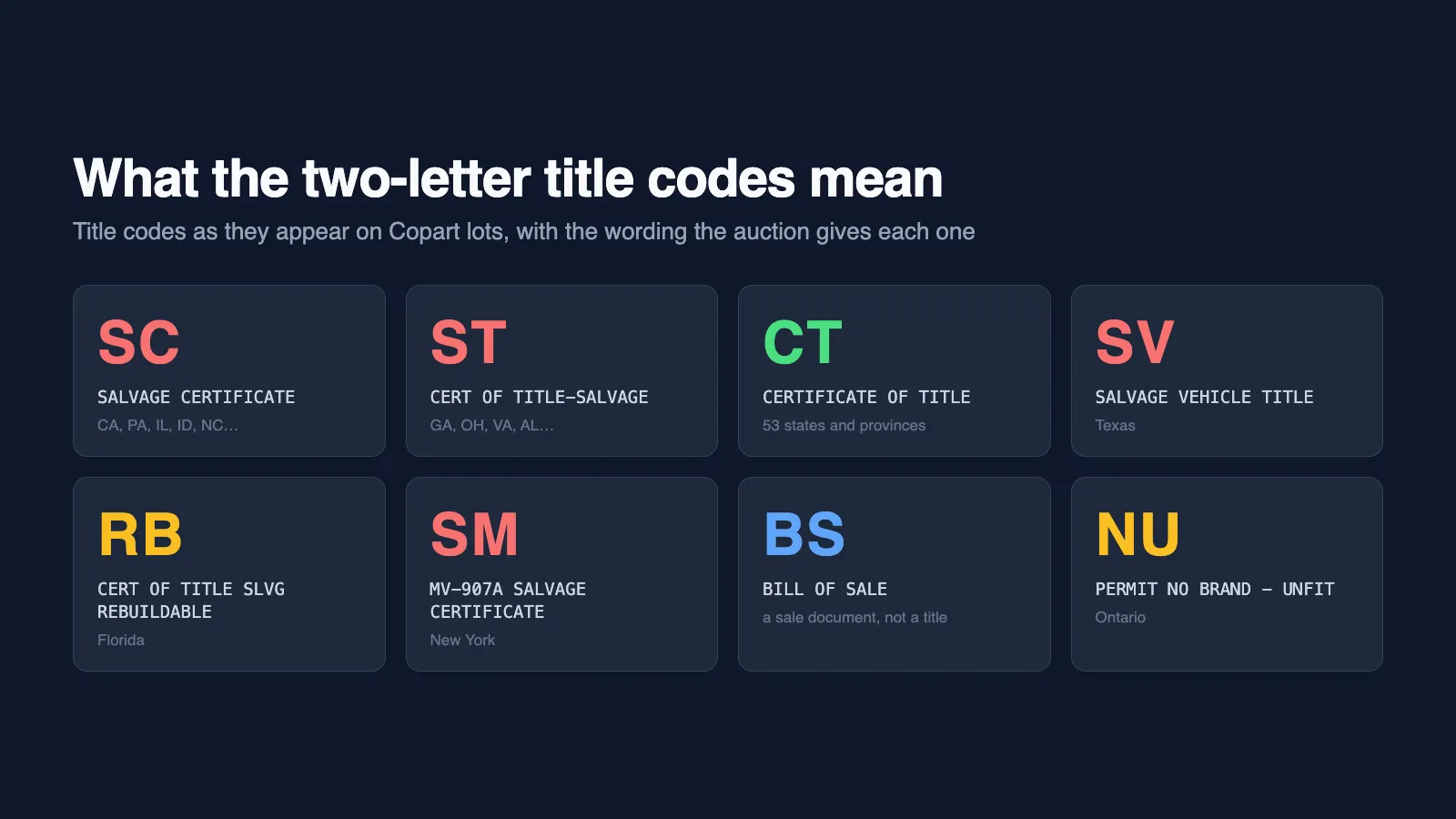
| SC | Salvage certificate | 30.9% | CA, PA, IL, ID, NC (19 in all) | A salvage document: the car was declared a total loss. It can be rebuilt, inspected and retitled in most states. |
| ST | Certificate of title, salvage | 22.0% | GA, OH, VA, AL, SC (36 in all) | A title with a salvage brand. Same meaning as SC; the states just call the document differently. |
| CT | Certificate of title | 17.4% | TX, MI, FL, VA, NY (53 in all) | An ordinary title with no brand. Copart groups it Clean. |
| SV | Salvage vehicle title | 5.9% | Texas only | The Texas salvage title. The car can be rebuilt and retitled. |
| RB | Cert of title, salvage rebuildable | 4.5% | Florida only | The Florida salvage certificate of title. Despite the wording, it is not a rebuilt title. |
| SM | MV-907A salvage certificate | 2.9% | New York only | New York's salvage certificate, form MV-907A. |
| BS | Bill of sale | 2.3% | WA, KY, CO (45 in all) | No title at all, only a sale document. What that allows depends entirely on the state. |
| S1 | Cert of salvage, over 75% damage | 1.7% | Maryland | A Maryland salvage certificate for heavy damage. |
| RS | Cert of title, rebuilt salvage | 1.6% | MA, MN (26 in all) | A car already rebuilt and back on a branded title, such as Massachusetts' "reconstructed" or Minnesota's "prior salvage". |
| CD | Certificate of destruction | 1.5% | Florida | Can never be titled again. Parts or scrap only. |
| DV | Dis/dlr/exp only clean title | 1.3% | CA (80% of them) | A clean title, but the wording limits it to dismantlers, dealers and exporters. |
| FS | Cert of title, salvage flood | 1.0% | IL, NJ, NY, OH, IN | A salvage title with a flood brand. |
| BP | Bill of sale (parts only) | 0.9% | WI, IN, GA, HI | A bill of sale, in several states marked parts only. |
| PS | Public, salvage title | 0.9% | Colorado | A Colorado salvage title, worded as open to public buyers. |
| CZ | Dealer only clean title | 0.8% | NC, MI | A clean title the wording limits to dealers. |
| PO | Cert of title, parts only | 0.5% | MI, NY, MN | Parts only. In New York it is the MV-907A marked parts only. |
Beyond the table, we counted more than 200 different codes in three months. Some say what they are (NX "nonrepairable title" in Texas, RP "repossession", LL "lemon law buyback"). Others appear on a lot page with no explanation at all. When you meet one, open the tooltip and check the issuing state's own rules before you bid.
Five states where the code changes everything
Texas: SV versus NX. An SV is a Texas salvage title: the repair cost exceeded the car's actual cash value, and the car can be rebuilt and retitled once a rebuilder applies, lists the major parts used and pays US$65 (Tex. Transp. Code §501.100). An NX is a nonrepairable title, and the statute says its owner may not "repair, rebuild, or reconstruct" the car or register it. Copart's NX tooltip quotes the legend printed on the title in capitals: the car may be used only as a source of parts or scrap metal. Texas also has an "export only" sale for buyers living outside the US, who must certify they will take the car out of the country and never title it in any state. Under the same law, a car sold that way counts as nonrepairable.
Florida: RB versus CD. Florida produces two very different codes. RB, the salvage certificate of title, is the rebuildable one, despite its wording. CD, the certificate of destruction, is the end of the road. Under Fla. Stat. §319.30, a car seven model years old or newer, worth at least US$7,500, whose repairs would cost 90% or more of its value gets a certificate of destruction, and so does an older or cheaper car whose only remaining value is as parts or scrap. The state "may not issue a certificate of title" for it ever again, and the certificate can be passed on at most twice before the car must be dismantled or destroyed. We saw 11,230 CD lots in three months, 98% of them from Florida.
New York: SM. SM is the MV-907A, New York's salvage certificate. Under New York DMV rules, a car is salvage when an insurer acquires it with an MV-907A or repairs would cost more than 75% of its value, and a rebuilt car must pass a DMV salvage examination before it gets a title again. Watch for the parts-only version: the DMV won't examine or title a car whose MV-907A is marked parts only, and Copart lists those under PO. If you plan to rebuild in another state, check first. Pennsylvania's reconstructed-vehicle fact sheet of February 2025 says it does not accept New York's Form 907A as proof of ownership.
California: SC and NR. California issues a salvage certificate when an insurer declares a total loss, and a separate nonrepairable certificate for cars kept only for parts or scrap, stripped hulls and burned shells. The California DMV says a nonrepairable vehicle "cannot be titled or re-registered", and the certificate can change hands only twice. California is the largest single source of SC lots (25% of them), and NR lots from California, Virginia, Arizona, Utah and Tennessee appear in Copart's Non Repairable group.
Bills of sale. A BS or BP lot comes with no title at all. Sometimes that's simply because the state doesn't title older cars: Georgia doesn't require a title for 1962 and older models and makes it optional through 1985 (Georgia DOR), and Alabama titles only vehicles up to 35 model years old (Alabama DOR). Sometimes it means the car is parts only: Kentucky's BS reads "PART ONLY/NO TITL", and several BP lots from Georgia and Hawaii are marked parts only. The BS lots in our sample also included trailers and construction equipment, not just cars. Before you bid on a bill-of-sale lot, find out exactly what document you'll get and whether your own state will title the car with it.
Codes that limit who can buy
Some codes carry a restriction in their wording: DV and DY read "DIS/DLR/EXP ONLY CLEAN TITLE", CZ "DEALER ONLY CLEAN TITLE", PX "NON PUBLIC CLEAN TITLE", and SD "DLR/DIS/EXP ONLY SALVAGE TITLE". Together, codes worded like this covered about 2.5% of Copart US lots. The wording points to dismantlers, dealers and exporters, though Copart doesn't publish a definition of the suffix. Only 0.9% of lots had wording that said the opposite, mainly Colorado's PS "PUBLIC - SALVAGE TITLE".
For the other 97% of lots, the code says nothing about who may buy. That depends on your state's licensing rules, which Copart explains on its licensing page: "States and Provinces all have different laws about who can bid and buy". Its search has a filter for lots open to buyers without a business licence. Licensing can run against intuition. On Copart's Texas page, an individual without a licence can buy salvage lots directly but needs a broker for titled items. Our guide to buying from Copart without a dealer licence explains how brokers fit in.
Next to the mileage, every lot also carries an odometer status. Our guide to Copart odometer statuses explains what ACTUAL, NOT ACTUAL, EXEMPT and EXCEEDS MECHANICAL LIMITS mean, and what they do to bids.
Copart Canada: permits, not titles
Canadian provinces don't issue titles the way US states do, so Copart Canada's codes describe permits, registrations and bills of sale. Over the same three months, four codes covered 81% of its 21,859 lots:
- NU, "PERMIT NO BRAND - UNFIT" (29.3%, all Ontario). The Ontario permit shows no brand, but the car is marked unfit to drive. Copart groups it Clean.
- ST, shown for Ontario as "PERMIT SALVAGE" (29.2%; Ontario and the Atlantic provinces). A salvage brand.
- BV, "BOS - SALVAGE" (12.3%, all Alberta). Alberta has no title system: a registration certificate "does not constitute proof of ownership", according to the Alberta government, so ownership passes on a bill of sale. Alberta's BS "BOS - ACTIVE" and OA "OOP - ACTIVE" (out of province) are lots Copart says can be registered.
- SR, "GRAVEMENT ACCIDENTE" (10.2%, all Quebec). A severely damaged vehicle in SAAQ terms, which can return to the road only after a rebuild file, a technical appraisal and a mechanical inspection (SAAQ).
Two Canadian codes mean parts only. IR is Ontario's "Irreparable" brand (Copart spells it "Irrepairable"): such a car "cannot be driven again in Ontario", according to the Ontario government. IP, "IRRECUPERABLE", is Quebec's equivalent, a vehicle that SAAQ says can never return to the road. Our guides to Ontario's salvage, irreparable and rebuilt brands and to Copart and IAA Canada fees and taxes go further.
Buying the car in the US instead? Our guide to importing a salvage car from the US to Canada covers the US titles Canada refuses, the 72-hour export rule, the 2026 surtax on US-built cars and the RIV inspection, with Copart US and Copart Canada bids compared model by model.
What the code does to the bids
Codes say something about the car, and bidders react to them. To compare like with like, we looked at the same five popular models, 2015 to 2022, across codes.

For the Camry, Accord, Civic and Corolla, ST and CT lots drew higher pre-auction bids than SC, and Texas SV lots were among the lowest. The median for 2015 to 2022 Honda Civics was US$1,150 on ST, US$1,250 on CT, US$750 on SC and US$425 on SV. For Corollas it was US$1,300, US$1,500, US$850 and US$750. The Ford F-150 broke the pattern: SC, ST and CT trucks drew about the same, US$1,950 to US$2,100.
Don't read those numbers as the price of a code. A pre-auction bid is the last bid we recorded before the live sale, not the final price. The codes also travel with other differences: where the car is, what kind of damage it has, and which insurers sell it. Maryland's S1 lots, for example, are by definition heavily damaged, yet they drew the highest median of all for Camrys. Even a Florida CD Camry, which can never be titled again, drew US$725 in pre-bids, because parts buyers bid on those too. The code tells you what you can do with the car. It doesn't set its value. Our guide to salvage versus clean title bids looks at that question in more depth.
The damage code is the other half of the listing. Our guide to Copart and IAA damage codes explains what FRONT END, MINOR DENTS/SCRATCHES, NORMAL WEAR or MECHANICAL tell you about a car, and what they don't.
A code is a listing, not a guarantee
Copart says so itself. Its member terms, revised July 9, 2026, list "title" and "title history" among the vehicle information members "shall not rely on" when deciding whether or how much to bid, and state that Copart "does not guarantee that any vehicle sold can be legally registered". They even give the classic example: a car bought on a clean title in one state may have to be resold on a salvage title in another.
So check three things beyond the code. The title rules of the state that will title the car: our guides to total loss thresholds and rebuilt title inspections cover all 50 states. The car's history: an NMVTIS report shows brands from every state, and SalvageAlert's free VIN check shows any earlier Copart or IAA lot for the same car, with the title it was listed under at the time. And the car itself, with an inspection if you can arrange one.
How we built this guide
The figures come from SalvageAlert's archive of Copart's daily Sales Data feed, analysed on a copy of the database on November 11, 2026. They cover 770,105 Copart US lots and 21,859 Copart Canada lots with a sale date between August 16 and November 10, 2026, one row per lot. A sale date means the lot went to auction, not that it sold. Bids are the last pre-auction bid recorded in the feed, never the final price, and lots with no pre-bid are left out of the medians. The "states" are the title states Copart lists. Copart's wording for each code comes from its lot pages, recorded by SalvageAlert when the same lots appeared in both of Copart's feeds. The tooltip texts and title groups were read on copart.com on November 11, 2026.
The state rules come from the Texas Transportation Code chapter 501, Florida Statutes §319.30, the New York, California and Pennsylvania motor vehicle departments, the Georgia and Alabama revenue departments, Ontario's Mandatory Vehicle Branding Program, the SAAQ and the Government of Alberta, all read on November 11, 2026.
Questions and answers
- What does SC mean on Copart?
- SC is a salvage certificate: the car was declared a total loss and comes with a salvage document rather than a regular title. It was the most common Copart US code, on 30.9% of lots between August and November 2026, mostly from California, Pennsylvania, Illinois, Idaho and North Carolina. In most states the car can be rebuilt, inspected and retitled.
- What is the difference between SC and ST on Copart?
- Both are salvage documents. ST is a certificate of title with a salvage brand, used by states such as Georgia, Ohio, Virginia and Alabama, while SC is a separate salvage certificate used by states such as California and Pennsylvania. What you can do with the car depends on the issuing state's rules, not on which of the two codes it carries.
- Does CT on Copart mean a clean title?
- CT is a certificate of title with no brand, and Copart places it in its Clean title group. Copart still disclaims the accuracy of title information, and a car bought on a clean title in one state may have to be resold as salvage in another, so check the VIN history before you bid.
- Which Copart title codes mean parts only?
- Among the common ones: CD, Florida's certificate of destruction; NX, the Texas nonrepairable title; NR, nonrepairable certificates from states such as California; PO, parts-only titles including New York's MV-907A marked parts only; Kentucky's BS bill of sale marked parts only; and in Canada IR, Ontario's irreparable brand, and IP, Quebec's irrecuperable status. These cars cannot be titled or driven again.
- What does BS mean on a Copart lot?
- BS means the car comes with a bill of sale instead of a title. It can be harmless, for example on older cars in states that don't title them, or an Alberta bill of sale that Copart says can be registered. It can also mean parts only, as with Kentucky's bill of sale marked part only, no title. Always read it with the state code.